Ich war Luft für sie, aber immerhin äußerte sie sich anerkennend über die gute Luft im Raum. Das war das Maximum an Respekt, das ich derzeit erwarten konnte.
Fragmente (8)
1 Antwort
Ich war Luft für sie, aber immerhin äußerte sie sich anerkennend über die gute Luft im Raum. Das war das Maximum an Respekt, das ich derzeit erwarten konnte.
Ein Gastspiel von Nadja Kwapil

I feel a little schadenfreude about the potential demise of Delicious. Not for popularizing social bookmarking, I like that a lot. What I resent them for is popularizing tags. Tags since infest services like Flickr, many blogs and Mendeley. If you listen to their advocates, you will be told that tags are one of the cornerstones of the Web 2.0, and even more so of the coming Web 3.0. To me, it seems that tags are an essentially useless technology that has somehow managed to become a remarkably long-living fad.
Sure, you can tag things (webpages, videos, books, research papers…) with keywords descriptive of their content. That is a 20th century librarian’s approach to making sure stuff can be easily retrieved. We live in the age of fulltext search, machine translation and the AwesomeBar (I myself stopped using Delicious the very moment Firefox 3 came out), at the dawn of semantic search and object-class detection in images. A Web service that relies on users sitting down and tagging stuff must be failing to use and further develop this technological potential.
So as long as you just want to retrieve stuff from a big bag of documents, search is your friend and tagging is slave labor. But what, the song of praise for tags goes on, if you want to order things, to structure them, to gain a deeper understanding of their relations and to improve your overview over the knowledge they represent? For this purpose, I hear, 20th century people used folders and put everything into a tree structure. The 21st century digital native social media Übermensch, on the other hand, uses tags. The obvious reason is that folders are so one-dimensional and rigid and you can classify things by only one dimension (or you have to first classify them by what to classify them by). Ordering schemes for pre-enlightened world views, those trees! The earth is a disc and built around heavenly Jerusalem, and everything has its one place and purpose, that’s the kind of insight that fits in folders, isn’t it?
I beg to differ. The “ordering schemes” you get by tagging stuff are aptly depicted by one of the most popular visualizations for tags: a cloud. A vapor. Nothing the human mind can really make sense of. Nothing that represents relations or insights. The only structured views on this cloud are filters, showing all items bearing a certain tag or combination of tags. Lists which are in no visible relation to each other. Venn bubbles bubbling around in the cloud. An excessively primitive database that does little more than a search engine but involves a hell of a lot more tedious human work. Concerning the collective knowledge aspect of this work, here’s what: in the time it would take you to tag a collection of bookmarks concerning a topic, rather write a blog article or a new paragraph for a Wikipedia article and let Google’s algorithms do the keyword extraction part for you. I’m sure you’re doing humanity a greater favor this way.
What you get by carefully organizing things into a tree structure, on the other hand, really is an ordering scheme. In the process, you weigh dimensions, you pick one as the one to order by, and discard other dimensions that are less useful for organizing your knowledge, honoring the fact that unlearning is an important part of learning. You think hard about things in order to find the best ordering scheme. Often you will find that there is no single dimension by which all things can usefully be ordered, and you will split them up into collections in each of which a different dimension is more relevant. These splits will likely be driven by your needs for your current project, and your information bookkeeping becomes goal-oriented. And isn’t this what dealing with the stuff and organizing it is all about: learning something from it so you can do something with it? And with the way the human mind works, I claim boldly, you haven’t really “got” something (information doesn’t turn into knowledge) until you have succeeded in putting it into a tree shape. Folders rock.
Lange Zeit dachte ich, ein Bandscheibenvorfall hieße Bandscheibenvorfall, weil er eben ein unvorhergesehenes Ereignis ist, das die Bandscheiben betrifft. Dann las ich noch einige Zeit lang den roten Knopf Geschäftsvorfall abbrechen an Geldautomaten als Geschäftsvorfall, abbrechen! und hielt Geschäftsvorfall für einen Euphemismus für Maskierte mit Maschinengewehren, die in die Bankfiliale rennen, während man gerade was abheben will.
Ach ja, die Indogermanen. Sie krabbelten eines Tages aus dem Schwarzen Meer und eroberten von dort aus ganz Eurasien. Und sie sprachen diese seltsame Sprache, in der jedes Wort mit einem Stern beginnt.
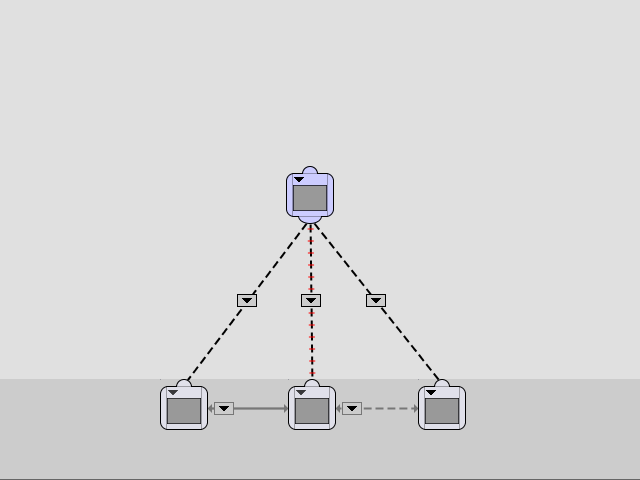
Nach dem seligen Zyklenfinder noch eine kleine Knobelaufgabe zur Entspannung für TIGERSearch-Freaks und -Veteranen: Was macht dieses Muster? Bonusfrage: Wozu dient die kleine Asymmetrie?
In the King of the Hill episode Leanne’s Saga, Luanne says:
Did you know there’s a spot on your foot that’s connected to every part of your whole body?
Is it just that she didn’t get reflexology quite right, or does every indeed take scope over the existential there in this sentence?
Gut, dass anscheinend auch Lebkuchenhäuser Seifenspender haben, die gelegentlich nachgefüllt werden müssen. Ansonsten wären Lea und Konstantin in Milchwald (Christoph Hochhäusler, 2003) bestimmt der bösen Hexe statt dem netten Kuba Lubinski in die Hände gefallen. So weit meine Theorie dazu, dass sein Auto mitten im Wald stand.
Inspiriert von Ursus Wehrli und LaTeX. Textquelle: taz.
Die Simulation macht’s moglich. Sei’s als Arche Noah vor der Haustur, als traute Heimat im fernen Paradiesgartchen – das Erdengluck wird rundum fabriziert. Im touristischen Ghetto feiert es frohliche Urstand. Wo sonst lassen sich Urlauberbedurfnisse so komprimiert aufbereiten? „Ich bin dieses Jahr ganz erschopft in den Urlaub gefahren. Und in meiner Erschopfung brauche ich den Schutz, die Sicherheit, das Versorgtwerden. Die gute Organisation meines Veranstalters hat mir schon wahrend der Reise die erste Gelassenheit ermoglicht; Pannen, Storungen, Konflikte hatte ich nur schlecht ertragen… Mein Touristenghetto prasentiert mir das Grandiose, das Irritierende der fremden sudlichen Welt portioniert, verkleinert und uberschaubar.“ Die Padagogin Gisela Wegener-Spohring spricht in ihrem Buch „Massentourismus und Padagogik“ aus, was die abgeschlossene Anlage so attraktiv macht: aufgehoben und versorgt, geschatzt, hofiert und angenommen zu sein. „Wann habe ich das sonst je? Ich weiß, daß ich dies alles bezahle, aber ich nehme es aufatmend an.“ Ein Seufzer, die Urlauberin fuhlt sich entlastet, sie spurt, ihre Bedurfnisse sind ihr vorausgeeilt.
¨¨¨¨¨¨¨¨¨¨¨
¨¨¨¨¨¨¨¨¨¨¨
¨